#Space #ElonMusk #BioTechnology #technology #Tesla #byUkiDLucas #public #Medium
The interplanetary domination, apparently.
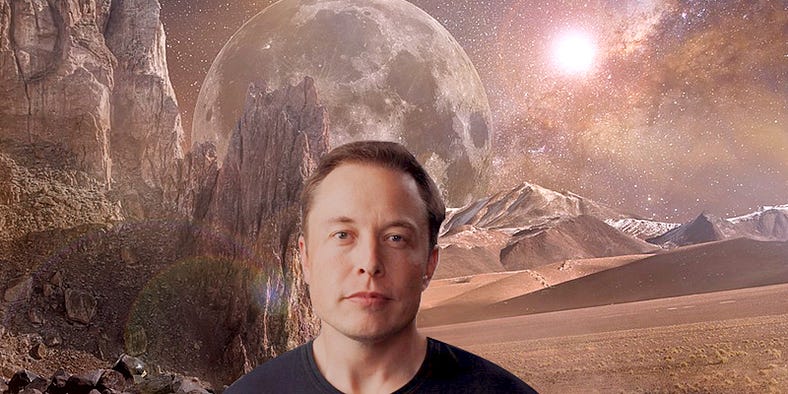
Elon Musk — image credit unknown
Elon Musk has said that he would like to die on Mars, preferably, not in the landing accident. Poetic. In fact, there is a joke around the Internet that Elon is an alien who tries to get back home. I find this whole idea as much amusing as thought stimulating.
Elon is often talking about the legacy of humans being an interplanetary species. Let’s get semi-serious and dissect how he is accomplishing this vision.
Since the original draft of this article, I started to use it as a thought experiment to help me better position myself for the future. I hope you might find it useful as well.
If he was packing for such a trip what would he need?
Spaceship
The space shuttles with their wings and landing gear were able to get to the International Space Station (ISP) and come back to Earth in one piece. It was a big money saver as a rocket is extremely expensive just to let it disintegrate in the mid-air after the first use.
However, Elon is not interested; he needs a spaceship that will fly and land without the atmosphere to support the landings without airstrips where wheels could be deployed. He needed vertical take-offs and vertical landings. In addition, he needs space crafts that are fully reusable to bring costs down to send regular people to Mars. He created SpaceX as a commercial company that really quickly became the primary space service company, for the International Space Station and communication satellite services, Starlink, but he has never lost his vision, the mission to Mars.
Autonomous electric vehicles
When we are talking about working in vast, uncolonized, and underdeveloped areas, let’s say deserts on the Mars surface, you need autonomy. In other words, there is a need for AI and autonomous robotic vehicles.
Hello, Tesla!
Elon, however, did not start with Mars rovers, he needed his technology to be developed and tested over millions of miles in different climates and terrains. What is a better way than to develop a company with millions of people being testers all over the planet?
There is no Oxygen in the atmosphere on Mars. Oxygen exists on Earth because plants create more of it then can be bound in the oxygenation process, the red-tint soils, for example, are nothing else than oxygenated iron, or rust. The internal combustion engines or even hybrid engines are useless in a world where Oxygen is at a premium. The only technology for Tesla that Elon was interested in is battery-operated autonomous vehicles.
He is so much in need of progress in this area that he released patents to the public domain, something that no other company would ever do unless there were bigger fish to fry.
Energy generation and storage
The next consideration to colonize Mars would be the energy needs; Mars has very sunny days due to a lack of substantial atmosphere. Therefore you can use solar panels. Elon created his own durable, highly modular, glass-like roof covering tiles (tesla.com/solarroof) that serve as solar panels that would be easy to transport and assemble. The durability and the small size of the tiles is the key advantage over traditional panels. I would not be surprised if he plans to make them on the spot, on Mars, Silica is a common mineral after all.
The sun does not shine at night, even on Mars. So, Elon decided to build his own battery mega and giga-factories. Again, he wants to test them beyond the academic labs, so he created the Tesla battery packs (tesla.com/powerwall) that will store the daytime solar energy and power your habitat, err, home, at night.
Tunnel boring, hyperloops, and mining
Let’s face it, without the thick atmosphere, the colonization of Mars is a scary proposition. The day-night temperature changes are extreme as the is no cushioning effect of the blanket of greenhouse gasses and there is no thermal sink such as lakes, seas, and oceans. Also, most meteors, even these the size of the grain of sand, might fly all the way to the surface of Mars without burning up and do so at speeds exceeding that of a sniper bullet. You can try to armor your shelter with the best material possible, but it is expensive at the city scale. We could consider some expensive Kevlar-ceramic sandwich panels that would have to be regularly replaced. As any military person knows there is no better way to hide from a speeding bullet than a thick layer of dirt. The logical solution is to dig underground, or rather bore tunnels to set the initial colony in the constant temperature shelter of the Mars soil. Elon has thought about it, too, by creating the “Boring Company.” Again, what is a better way to prove the concept than to Swiss-cheese under the desert colony on Earth, also known as Las Vegas.
How about the fast transportation system for these tunnels? He designed the magnetic monorails (Hyperloop) that are more precise, faster, and more economical than the wheeled vehicles. In the future, such hyperloop will operate the pods in the vacuum to remove air resistance at speeds exceeding the sound, covering cross-continental distances in half the time of today’s airplane travel.
The tunnels, of course, would allow Elon to mine the minerals on Earth and Mars, too.
So what is next for Elon?
The six months travel to Mars is a long time, what comes to mind is cryogenic hibernation, but I do not see it as an immediate solution. We are not frogs, and we do not like to freeze ourselves every half-a-year, yet.
I imagine people will spend space travel suspended in a circulating amniotic fluid with electrode-induced muscle exercises and mental stimulation provided by NeuraLink virtual reality (VR). You will not be bored on the way to Mars. You will entertain, study, and socially interact, albeit only in your brain. You will not lose a gram of muscle either.
At this moment, bio-engineering human is an ethical minefield, however, in the future, I predict that people will consider un-ethical not to adapt to the environmental conditions.
Once we reach Mars, we will have to adapt it to our needs. That is what humans do. On a recent trip to Washington State with kids, we immediately busied ourselves in building a rock dam on the mountain stream. It is in human nature.
Climate and teraforming
I bet Elon is taking on the bio-engineering companies that would be able to create the Martian microflora.
For example, cyanobacteria could utilize sunlight while breaking minerals commonly found on Mars to release Oxygen and Nitrogen to the atmosphere. As the biology refresher, the side product of the photosynthesis is Oxygen and Carbohydrates (sugars and starches), the food for the photosynthetic organism is water, carbon dioxide, and minerals such as nitrogen (ammonia compounds), phosphorus, and potassium.
There is water on Mars in form of ice and permafrost. There are many ways of accessing them from space mirrors to nuclear explosions (please no!), I think the safest bet would be to build domes that create atmospheric “lagoons” that breed the photosynthetic microflora.
There is some Carbon Dioxide in Mars’ atmosphere, too, but it is a fraction from what we have on Earth. There is Magnesite (MgCO3) all over the surface, but if carbon is something we might have to import, we should perfect the technology to making spaceship structural carbon nanotubes, coal, graphite, and industrial diamonds, all of which are pure carbon and could be used and recycled into the plant food.
The future bio-engineered martian bugs not having any competition (predators) would be able to colonize Mars at an astronomical speed. They would have to survive extreme heat and cold, have the ability to be spread by air dusting, and have to be drought tolerant.
Therefore, I expect the next venture of Elon will be in biotech, and it will have to do with photosynthetic algae or cyanobacteria on the surface, and with bacteria that process different types of minerals underneath the surface.
A while ago, I was excited about a startup idea that wanted to create oil-producing algae. The idea was to create a large matrix of aquariums and plastic pipes using abundant sunlight in Mexico’s Baja California area. It was to be located near a coal-burning plant producing vast quantities of Carbon Dioxide and close to the sea-shore, the source of the water and essential minerals. Such algae can generate up to 50% of its body mass in oil; the whole plant could be edible, too. The oil, or carbohydrates, is the raw material for plastics as well as rocket fuel, Kerosene. The microorganisms can also produce Methane, another important fuel.
About the author
Uki is a system architect, program technical leader, currently working on ADAS/AD at Harman International, a Samsung company. Opinions are my own.
This post, originally written on Chicago’s train ride to work is made for entertainment purposes and should not be taken too seriously. If you enjoyed it, please “Like it”, “Share it” and “Subscribe” so I know you would like me to venture into such subjects.